Language English
Yakitori Audio Guide
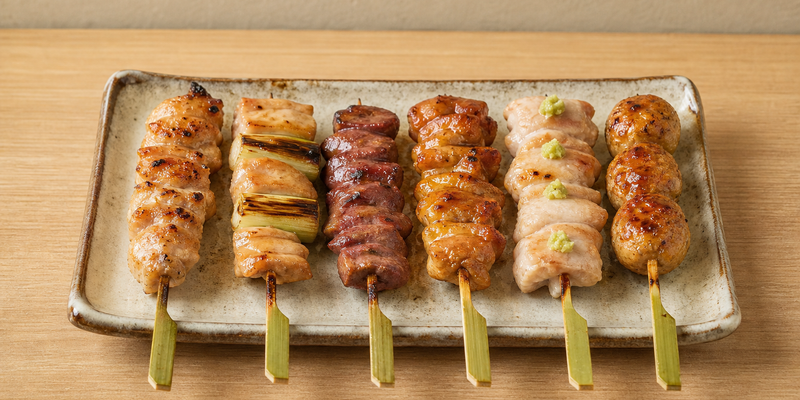
Skewers crackle over a charcoal fire and fragrant smoke drifts through the alley: that is Japanese yakitori. Where did this humble skewer, long loved under the red lanterns of the izakaya, come from? Across six parts we trace its history, the cuts from thigh to breast to tsukune, the choice between sauce and salt, the art of grilling, when Japanese people eat it, and how to order and enjoy.
- 122 audio guides across Japan — Tokyo, Kyoto & Osaka
- Made for walking — it tells you where to stand and what to look at
- 3 days (1 city + food) ¥2,000 · 1 month (all cities) ¥3,000or this guide only ¥300 (7 days)
- 1Welcome to the World of YakitoriFree
- 2How a Skewer Is Made
- 3The Story of Yakitori
- 4Cuts and Regions
- 5Yakitori and the Japanese
- 6Fascinating Facts
- 7Tips for Ordering and Eating
All chapters of this guide · 7 days — ¥300
Welcome to the World of Yakitori
Transcript
Welcome to the World of Yakitori. Picture a narrow lane at dusk. Red paper lanterns sway over a doorway, and a thin blue smoke drifts out into the street, carrying a smell you can almost taste: sweet sauce caramelizing on hot coals. Inside, behind a low counter, a cook stands over a long, glowing grill. Dozens of small skewers lie in rows across it. With a flick of the wrist, he turns them all, one after another, and the coals hiss as a drop of fat falls through. Beside you, a stranger lifts a skewer, tears off a piece with his teeth, and reaches for his glass. Let's begin with a surprise. Today you can find yakitori shops that are treated like fine dining. But the very first yakitori stalls, in Tokyo, in the middle of the Meiji era, were built on something that other people threw away. Not the best cuts. According to one account, the scraps and offal left over from restaurants. Over the next seven chapters, we'll look at this skewer from every side: how it is made, where it came from, how it changes from town to town, and how to order it yourself. Three things are waiting for you along the way. First, even the finest skewer today began with a stall grilling something that restaurants threw away. You'll learn exactly what it was in Chapter 3. Second, the charcoal for yakitori is what's left after most of the wood vanishes inside a kiln. Chapter 2 tells you how much disappears. Third, some famous yakitori towns don't use chicken at all. Chapter 4 names where, and what they use instead. And one question to carry with you. Imagine you're standing at a street stall with a cup in one hand, and only the other hand free to eat. What shape would your food take? Keep that in mind. Listen for why yakitori is bite-sized and skewered. The answer comes in Chapter 3, and once more at the very end. Here's how this guide works. There are seven chapters, about thirty minutes in all. Chapter 2 follows one skewer from the cutting board to the coals. Chapter 3 is the story, from the first chickens in Japan to the smoky markets of postwar Tokyo. Chapter 4 is a tour of the cuts of the bird, and of the regions that do yakitori their own way. Chapter 5 is about the people who eat it, and a few things that are said about it. Chapter 6 is a handful of facts that surprise almost everyone. And Chapter 7 is short and practical: how to order and eat as if you'd done it for years. That last one is perfect for when you're standing outside a shop. Ready? Let's go and find that lane, and watch the coals.
Explore the city. Taste Japan. Hear the Story.
Discover the landmarks of Tokyo, Kyoto & Osaka and Japanese food culture with GuideTunes — an audio guide app made for international travelers. From temples, streets, and historic spots to ramen, sushi, tempura, and local food experiences, GuideTunes helps you understand the stories behind what you see and what you eat. Make every walk and every meal part of your journey in Japan.