Language English
Japanese Curry Audio Guide
A golden roux spreading over white rice, curry rice is one of Japan's best-loved national dishes. Surprisingly, it reached these shores from India by way of Britain. Across six parts we trace that unexpected British route, meet its many kinds like katsu curry, travel to regional styles such as soup curry, learn when it is eaten, master eating it with a single spoon, and savor the joy of comparing shops.
- 122 audio guides across Japan — Tokyo, Kyoto & Osaka
- Made for walking — it tells you where to stand and what to look at
- 3 days (1 city + food) ¥2,000 · 1 month (all cities) ¥3,000or this guide only ¥300 (7 days)
- 1Welcome to the World of Japanese CurryFree
- 2How a Plate of Curry Is Made
- 3The Story of Japanese Curry
- 4Regional Tastes and Variations
- 5Curry and the Japanese People
- 6Fascinating Curry Trivia
- 7Tips for Enjoying Japanese Curry
All chapters of this guide · 7 days — ¥300
Welcome to the World of Japanese Curry
Transcript
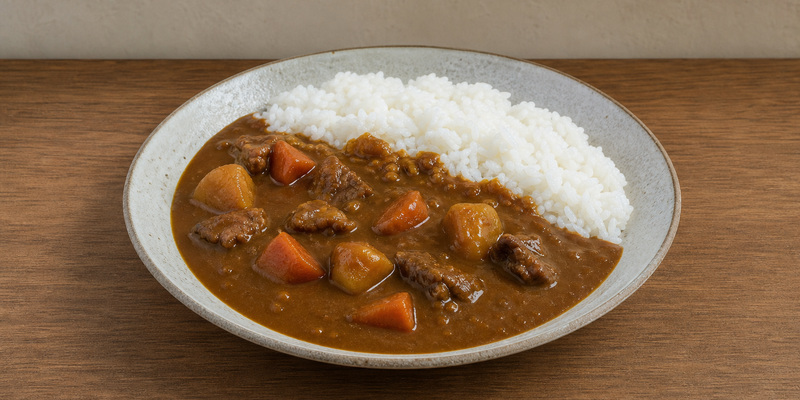
Welcome to the World of Japanese Curry. Picture a plate set down in front of you. A mound of white rice, and over it a thick, glossy, brown sauce, still steaming. The smell reaches you first: warm spices, sweet onion, something deep and a little smoky. A spoon rests on the rim of the plate. In Japan, this is one of the most ordinary meals you can eat. It is also one of the most loved. Let's begin with a surprise. Curry was born in India. Yet for the Japanese people of the Meiji era, the years when Japan was throwing its doors wide to the world, curry was not an Indian dish at all. It was a Western dish, a taste of the new, modern age. It was something to dream about. So how did a spiced dish from India become a Western dish in Japan? That is the story of this guide. Over the next seven chapters, we are going to take this plate apart, and then put it back together with its history. Three things are waiting for you along the way. First, the thick sauce. Most curries in the world are thin, or chunky, or oily. Japanese curry is thick and smooth, and it may have a reason that comes from life aboard a ship. Second, authentic Indian-style curry. It reached Japan through a bakery, and a man on the run from British authorities. Third, the little pouch of curry you can find on any Japanese supermarket shelf. The very first one of its kind in the world was born in Japan, and its making borrowed a surprising medical technology. And one question to carry with you. Curry was born in India. So why is it considered a Western dish in Japan, and why does it come poured thick over rice? Keep a guess in mind. The answer comes in Chapter 3, and once more at the very end. Here is how this guide works. There are seven chapters, about thirty minutes in all. Chapter 2 takes the plate apart: the spices, the roux, the stock, and the pouch. Chapter 3 is the story, from a ship's deck in 1863 to the arrival of the ready-made roux. Chapter 4 travels around Japan, one curry at a time, including curry noodles and curry bread. Chapter 5 is about the people who eat it here, and the things they say about it. Chapter 6 is a handful of facts that surprise almost everyone. And Chapter 7 is short and practical: how to order and enjoy your plate as if you had been doing it for years. That last one is perfect for when you are standing at a restaurant door. Ready? Let's look at what is on the plate.
Explore the city. Taste Japan. Hear the Story.
Discover the landmarks of Tokyo, Kyoto & Osaka and Japanese food culture with GuideTunes — an audio guide app made for international travelers. From temples, streets, and historic spots to ramen, sushi, tempura, and local food experiences, GuideTunes helps you understand the stories behind what you see and what you eat. Make every walk and every meal part of your journey in Japan.