Language English
Wagashi Audio Guide
In a small wagashi that fits in your palm lie the four seasons of Japan and a thousand years of history. From the nuts and fruit that were the earliest "sweets," to the meeting with sweet bean paste, the sugar brought by foreign traders, the refined confections shaped by the tea ceremony, and the daifuku and yokan that blossomed in old Edo. This guide gently introduces the history, types, regions, etiquette, and pleasures of Japanese sweets, for first-timers too.
- 122 audio guides across Japan — Tokyo, Kyoto & Osaka
- Made for walking — it tells you where to stand and what to look at
- 3 days (1 city + food) ¥2,000 · 1 month (all cities) ¥3,000or this guide only ¥300 (7 days)
- 1Welcome to the World of WagashiFree
- 2How a Wagashi Is Made
- 3The Story of Wagashi
- 4Kinds of Wagashi and the Taste of Each Place
- 5Wagashi in Japanese Life
- 6Fascinating Facts About Wagashi
- 7How to Enjoy Wagashi
All chapters of this guide · 7 days — ¥300
Welcome to the World of Wagashi
Transcript
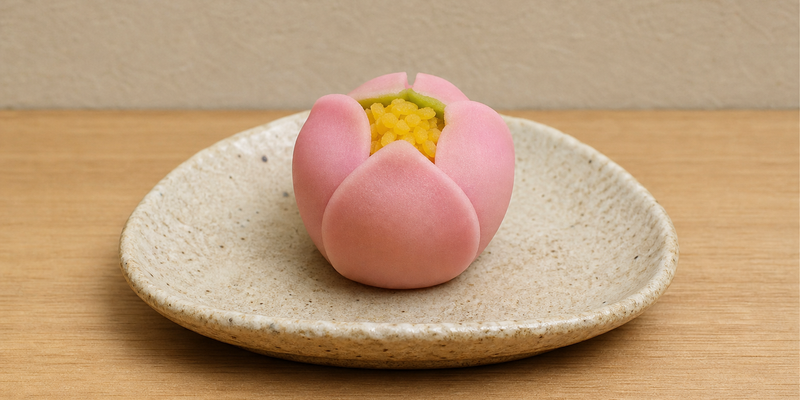
Welcome to the World of Wagashi. Picture a small lacquered tray on a low table. On it sits a sweet no bigger than a plum, resting in the palm of your hand. It is a flower, or at least it looks like one. Pale pink at the center, fading to white at the edges, with petals folded so finely that you can see the faint lines left by a wooden tool. Beside it lies a slim wooden pick, and when you lift it, you catch a clean, woody scent. Nothing about this little flower is loud. It simply waits for you to look. Here is a surprise to begin with. These delicate, jewel-like sweets, the kind called nerikiri, are not nearly as old as you might think. Beautiful, fine sweets like this were made only from the Edo period onward. Japan's sweet-making goes back to the Jomon period, to people grinding nuts into balls. But the artwork in your hand is a much later flowering. Over the next seven chapters, we will look at this tiny object from every side. Three things are waiting for you along the way. First: the word yokan, the dense, glossy bean jelly you will see in every sweet shop. The "sheep" in its name is not an accident. It really does have to do with lamb, and the reason is stranger than you would guess. Second: one day, more than twenty thousand sweets were laid out across a single hall in Edo Castle. What was that day for? There is a reason it is still remembered today. Third: one sweet was nicknamed "the one the neighbor never knows about." Which sweet, and why? A small and charming secret. And one question to carry with you. In summer, you will find a sweet called minazuki. It is a white, cool-looking slab, cut into triangles, with adzuki beans scattered on top. Why a triangle? And what is the meaning of those beans? Keep a guess in mind. The answer comes in Chapter 5, and once more at the very end. Here is how this guide works. There are seven chapters, about thirty minutes in all. Chapter 2 takes a sweet apart: bean paste, sugar, flour, and the small tools that shape them. Chapter 3 is the story, from nut dumplings in the Jomon period to the day the word "wagashi" was needed at all. Chapter 4 sorts the sweets by kind, by season and by place. Chapter 5 is about the people who eat them, and the days of the year they belong to. Chapter 6 is a handful of facts that surprise almost everyone. And Chapter 7 is short and practical: how to pick up and enjoy your sweet as if you had done it all your life. That one is perfect for when you are standing at a shop counter. Ready? Let's look at the sweet in your hand.
Explore the city. Taste Japan. Hear the Story.
Discover the landmarks of Tokyo, Kyoto & Osaka and Japanese food culture with GuideTunes — an audio guide app made for international travelers. From temples, streets, and historic spots to ramen, sushi, tempura, and local food experiences, GuideTunes helps you understand the stories behind what you see and what you eat. Make every walk and every meal part of your journey in Japan.