Language English
Udon Audio Guide
One thick, white strand of noodle: udon. From a wheat culture that some say Kukai brought home, to the famous styles of Sanuki and Inaniwa, the clear broth of the west and the dark broth of the east, the art of slurping, and how to order at a self-service shop. A full-bowl audio guide to the noodle that quietly shares the everyday life of Japan.
- 122 audio guides across Japan — Tokyo, Kyoto & Osaka
- Made for walking — it tells you where to stand and what to look at
- 3 days (1 city + food) ¥2,000 · 1 month (all cities) ¥3,000or this guide only ¥300 (7 days)
- 1Welcome to the World of UdonFree
- 2How a Bowl of Udon Is Made
- 3The Story of Udon
- 4Regional Udon Around Japan
- 5Udon and the Japanese
- 6Fascinating Udon Trivia
- 7A Few Tips for Eating Udon
All chapters of this guide · 7 days — ¥300
Welcome to the World of Udon
Transcript
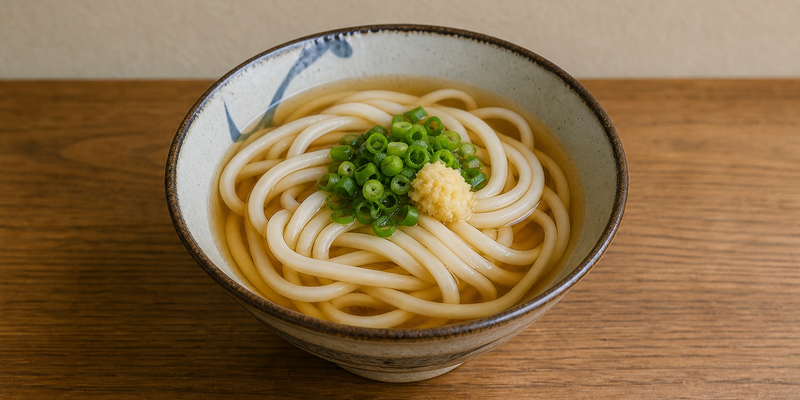
Welcome to the World of Udon. Picture a pot the size of a bathtub, rolling at a boil, and a cloud of steam rising off it into a cold morning. Beside it, a worker stands on a sheet of plastic, shifting his weight from foot to foot in a steady rhythm. Underneath him lies a great pale mass of dough, and every step makes a soft, heavy thud. Thud, shift, thud, shift. Nearby, a long blade comes down, cutting the dough into noodles with edges as sharp as the corner of a box. A bowl is filled, a ladle of hot broth goes in, and the whole thing arrives in front of you smelling of the sea. Let's begin with the surprise. What goes into those noodles is almost embarrassingly simple: wheat flour, salt and water. Nothing else. That's all. And yet, from those three plain things, Japan has made noodles that are springy, noodles that are flat as ribbons, noodles as thick as your finger, and noodles so hard that people fight over how to describe them. Same three ingredients. Completely different dishes. The road we'll travel is paved with udon, the thick wheat noodle. We'll visit Kagawa, Akita, Gunma, Mie and the foot of Mount Fuji. Soba, the buckwheat noodle, has its own separate guide. Here, it appears only briefly, in Chapter 6, as a short comparison, so you can see where the two part ways. Three things are waiting for you along the way. First, the famous chewy bite of Sanuki udon, the style from Kagawa, is made with the feet. In Chapter 2, you'll hear how that works, and what it sounds like. Second, udon makers change their salt water between summer and winter, following an old rule of thumb that's still recited today. Chapter 2 has it. Third, in Akita, a flat dried udon called Inaniwa was made for generations with a method taught to only one heir. Chapter 3 tells you when that secret was finally shared with everyone. And one question to carry with you. All of these noodles are called udon, yet travel across Japan and they seem like different dishes. What makes the biggest difference? Keep a guess in mind. We'll return to it at the very end of the trip. Here's how this guide works. There are seven chapters, about thirty minutes in all. Chapter 2 takes the bowl apart: the dough, the knife, the pot and the broth. Chapter 3 is the story, from a monk's legend more than twelve hundred years ago to a bridge across the sea. Chapter 4 is a map of Japan in bowls. Chapter 5 is about the people who eat it, and the days they eat it on. Chapter 6 is a handful of facts that surprise almost everyone. And Chapter 7 is short and practical: how to order and eat your bowl as if you had done it for years. Ready? Let's step into the kitchen.
Explore the city. Taste Japan. Hear the Story.
Discover the landmarks of Tokyo, Kyoto & Osaka and Japanese food culture with GuideTunes — an audio guide app made for international travelers. From temples, streets, and historic spots to ramen, sushi, tempura, and local food experiences, GuideTunes helps you understand the stories behind what you see and what you eat. Make every walk and every meal part of your journey in Japan.