Language English
Soba Audio Guide
Thin, fragrant, and made to slide smoothly down the throat, soba is a noodle woven deep into everyday Japanese life, born from flour ground from buckwheat. Across six parts we trace its history flowering in old Edo, decode its many styles from cold mori to hot kake, travel to regional homes like Shinshu and Izumo, unpack the year-end soba custom, share the knack of slurping, and enjoy the final cup of sobayu.
- 122 audio guides across Japan — Tokyo, Kyoto & Osaka
- Made for walking — it tells you where to stand and what to look at
- 3 days (1 city + food) ¥2,000 · 1 month (all cities) ¥3,000or this guide only ¥300 (7 days)
- 1Welcome to the World of SobaFree
- 2How a Bowl of Soba Is Made
- 3The Story of Soba
- 4Kinds of Soba and Tastes of the Land
- 5The Japanese and Soba
- 6Things Worth Knowing About Soba
- 7A Few Tips for Eating Soba
All chapters of this guide · 7 days — ¥300
Welcome to the World of Soba
Transcript
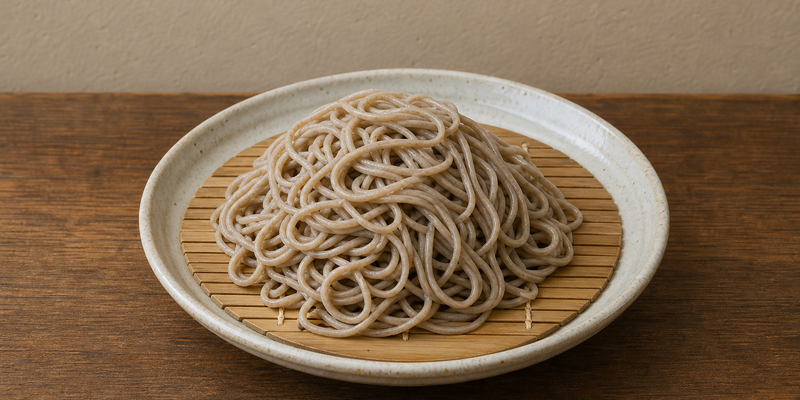
Welcome to the World of Soba. Picture a dim kitchen early in the morning. On a wide wooden board, a pile of pale gray flour, and beside it a bowl of cold water. Hands sweep the water through the flour in quick circles until the powder turns into crumbs, and the crumbs into a single smooth ball. Then comes the soft, steady rumble of a long rolling pin, and finally a heavy knife going tock, tock, tock against the board, cutting the sheet into thin, even strands. A short time in a pot of boiling water. A rinse in cold water. And a tray of dark, fragrant noodles lands in front of you, with a small cup of sauce on the side. That is soba, Japan's buckwheat noodle. You will meet it all over Tokyo: in tiny shops with sliding doors, in station corridors, in tall office buildings, and in old family restaurants. Many travelers walk past it on the way to ramen or sushi. Over the next thirty minutes, I would like to change that. Let's begin with something surprising. Buckwheat has been seen in Japan since the Jomon period, and people have eaten it for at least fifteen hundred years. And yet the noodle itself, the long thin strands we call soba today, has a surprisingly short history. For most of the time buckwheat has been eaten in Japan, nobody ate it as a noodle at all. They ate it as whole grains, or as a thick paste stirred up with hot water. The noodle, called soba-kiri, appeared only shortly before the Edo period. In a country with such old food traditions, that makes soba a relative newcomer. Three promises for the road ahead. First, you will learn when soba is thought to have become a noodle, and why no one can say exactly where or when. Second, in Izumo, in western Japan, the soba is much darker than almost anywhere else. You will find out why, and the answer lies in how the little seed is milled. Third, in the northern prefecture of Iwate, there is a way of eating soba in which a server keeps dropping fresh noodles into your bowl, again and again. You will learn the one thing you must do to make the refills end. And one question to carry with you. Some soba is made from buckwheat flour alone, with nothing else added. It is called juwari soba, and it has a reputation for being very hard to make well. Why? Keep a guess in mind. The answer comes in Chapter 2, and once more at the very end. Here is how this guide works. There are seven chapters, about thirty minutes in all. Chapter 2 takes you into the kitchen to see how a bowl of soba is made. Chapter 3 tells the story of how a plain grain became a famous noodle. Chapter 4 travels the country, from Tokyo to Izumo to Iwate, one bowl at a time. Chapter 5 is about the people who eat it here, and the beliefs that surround it. Chapter 6 collects small facts that surprise almost everyone. And Chapter 7 is short and practical: how to order and eat your soba with confidence. Ready? Let's start in the kitchen.
Explore the city. Taste Japan. Hear the Story.
Discover the landmarks of Tokyo, Kyoto & Osaka and Japanese food culture with GuideTunes — an audio guide app made for international travelers. From temples, streets, and historic spots to ramen, sushi, tempura, and local food experiences, GuideTunes helps you understand the stories behind what you see and what you eat. Make every walk and every meal part of your journey in Japan.