Language English
Unagi Audio Guide
Unagi, freshwater eel, is a dish Japanese people have cherished for over a thousand years as a source of summer stamina. From its ancient roots in Japan's oldest poetry to the great divide between the Kanto and Kansai grilling styles, Nagoya's hitsumabushi, the midsummer eel-eating custom, and how to order at a specialist restaurant — this guide gently unpacks the craft and the stories folded into a single skewer.
- 122 audio guides across Japan — Tokyo, Kyoto & Osaka
- Made for walking — it tells you where to stand and what to look at
- 3 days (1 city + food) ¥2,000 · 1 month (all cities) ¥3,000or this guide only ¥300 (7 days)
- 1Welcome to the World of UnagiFree
- 2How a Plate of Unagi Is Made
- 3The Story of Unagi
- 4Regional Styles and Local Flavors
- 5Japanese People and Unagi
- 6Fascinating Facts About Unagi
- 7Tips for Eating Unagi
All chapters of this guide · 7 days — ¥300
Welcome to the World of Unagi
Transcript
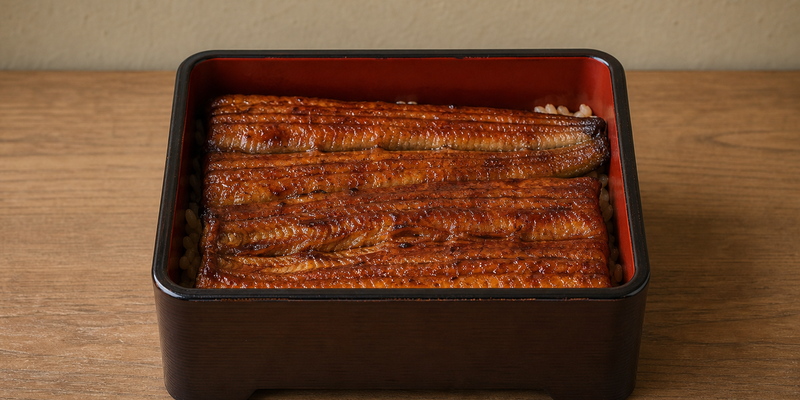
Welcome to the World of Unagi. Picture a small shop on a narrow street. Behind the counter, a cook fans a row of skewers over a bed of glowing charcoal. Every time the sauce drips onto the coals, a cloud of smoke rises, thick with the smell of caramelized soy sauce and sweet rice wine. The skewered fish crackle and turn a deep, glossy brown. Even before you sit down, your stomach has made up its mind. That fish is unagi, Japanese freshwater eel. And here is the first surprise. The journey of this one plate did not begin in a river, or in a pond, or in a kitchen. It began about two thousand five hundred kilometers south of Japan, out on the wide ocean, in a spot so remote that nobody found a single egg there until 2009. For centuries, one of the great puzzles of biology was simply this: where do eels come from? The Greek philosopher Aristotle looked at the question and decided that eels must arise on their own, out of river mud. He was wrong, but he had a reason. No one had ever seen an eel egg. Over the next seven chapters, we are going to follow that mystery from the deep sea to the charcoal grill, and then to the table in front of you. Three things are waiting for you along the way. First, a plate of unagi begins with a baby eel about the size of a toothpick, and so clear you can see right through it. You will hear how it grows, and an unexpected reason eels are kept under running water before they are shipped. Second, the famous eel rice bowl. Surprisingly, it was not invented by an eel cook at all. So who thought of it, and why? Third, there is a day in the middle of summer when Japanese people line up for unagi. A famous name is attached to the custom, and a very surprising footnote is attached to him. And one question to carry with you. Far from which place, and about how many kilometers away, does the eel lay its eggs? And when did humans finally pin down the spot? Keep a guess in mind. The full answer comes in Chapter 6, and once more at the very end. Here is how this guide works. There are seven chapters, about thirty minutes in all. Chapter 2 is how a plate of unagi is made, from the glassy baby eel to the glazed fillet. Chapter 3 is the story, from ancient shell mounds and a teasing poem to the farms of the Meiji era. Chapter 4 travels Japan, from the east-versus-west split in the way eel is cut to the three-step bowl of Nagoya. Chapter 5 is about the people who eat it here, and the beliefs that gather around it. Chapter 6 is a handful of facts that surprise almost everyone, including the plain facts about how many eels are left. And Chapter 7 is short and practical: how to order and eat your unagi with confidence. That last one is perfect for when you are waiting for a table. Ready? Let's go down to the sea.
Explore the city. Taste Japan. Hear the Story.
Discover the landmarks of Tokyo, Kyoto & Osaka and Japanese food culture with GuideTunes — an audio guide app made for international travelers. From temples, streets, and historic spots to ramen, sushi, tempura, and local food experiences, GuideTunes helps you understand the stories behind what you see and what you eat. Make every walk and every meal part of your journey in Japan.