Language English
Natto Audio Guide
Stringy and humble, natto is a quiet co-star of the Japanese morning, a nutritious traditional food made by fermenting soybeans. Across six parts we trace its history born from straw, tell apart whole-bean and chopped types, visit its famous home of Mito, unpack the breakfast culture, learn how to mix it and the manners of its sauce, and share beginner's tips so that even those who find it daunting can enjoy this deep and fascinating dish.
- 122 audio guides across Japan — Tokyo, Kyoto & Osaka
- Made for walking — it tells you where to stand and what to look at
- 3 days (1 city + food) ¥2,000 · 1 month (all cities) ¥3,000or this guide only ¥300 (7 days)
- 1Welcome to the World of NattoFree
- 2How Natto Is Made
- 3The Story of Natto
- 4Kinds and Local Flavors
- 5Natto and Daily Life in Japan
- 6Curious Facts About Natto
- 7A Few Tips for Eating Natto
All chapters of this guide · 7 days — ¥300
Welcome to the World of Natto
Transcript
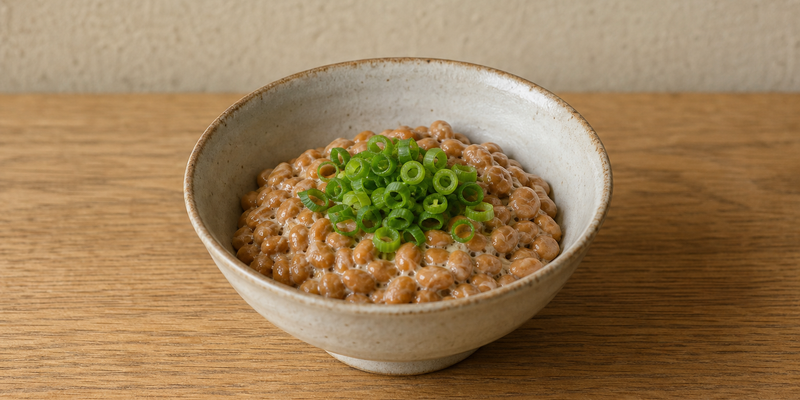
Welcome to the World of Natto. Picture a small breakfast table in Japan, early on a quiet morning. Beside a bowl of steaming rice, there is a little plastic tray of dark brown beans. Someone lifts a pair of chopsticks and begins to stir. At first there is only a soft rustle. Then the beans start to cling together, and thin, glossy threads rise up from the tray, stretching and tangling with every turn. The smell reaches you a moment later: earthy, a little sharp, impossible to ignore. This is natto, fermented soybeans, and for millions of people in Japan it is simply what mornings taste like. Let's begin with a strange fact. In one experiment, the sticky strands of natto were pulled out to more than twenty meters, and they still had not broken. Twenty meters, from a few small beans. Hold on to that image, because in a moment we'll find out what those threads are actually made of. Many travelers meet natto with a mixture of curiosity and alarm. It's often said that people outside Japan find the smell and the stickiness hard to take. If that's you, you're in good company, and nobody here will mind if you decide it isn't for you. But there is a story inside this humble tray, and it's worth hearing even if you never lift a single bean. Nobody knows exactly when, where or by whom natto was first made. Every theory agrees on one thing, though: it began when boiled soybeans met rice straw. How such a simple meeting could change a bean so completely is the mystery we will unwrap over the next seven chapters. Three things are waiting for you along the way. First, what is the sticky thread of natto actually made of? The answer is stranger than you might expect. Second, why is the bottom of a store-bought natto container deliberately bumpy? That bump is a small piece of clever engineering. Third, the very first natto in writing was not the natto we know today. What was it like? You may be surprised to hear that it didn't stretch at all. And here is one question to carry with you. Roughly how many natto bacteria cling to a single stalk of rice straw? And by what accident is natto said to have been born? Keep a guess in mind. The answers come in Chapter 2 and Chapter 3, and once more at the very end. Here's how this guide works. There are seven chapters, about thirty minutes in all. Chapter 2 follows the beans from washing and steaming to the warm fermentation room. Chapter 3 is the story: ancient straw houses, a warlord's horses, a street seller's cry, and a wartime nutrition officer. Chapter 4 travels around Japan, from salty temple natto to natto dried in the sun. Chapter 5 is about the people who eat it, and what they say it does for them. Chapter 6 is a handful of facts that surprise almost everyone. And Chapter 7 is short and practical: how to stir it, how to season it, and how to approach it if the smell worries you. Ready? Let's go back to where it all begins: a single bean.
Explore the city. Taste Japan. Hear the Story.
Discover the landmarks of Tokyo, Kyoto & Osaka and Japanese food culture with GuideTunes — an audio guide app made for international travelers. From temples, streets, and historic spots to ramen, sushi, tempura, and local food experiences, GuideTunes helps you understand the stories behind what you see and what you eat. Make every walk and every meal part of your journey in Japan.