Language English
Kaisendon Audio Guide
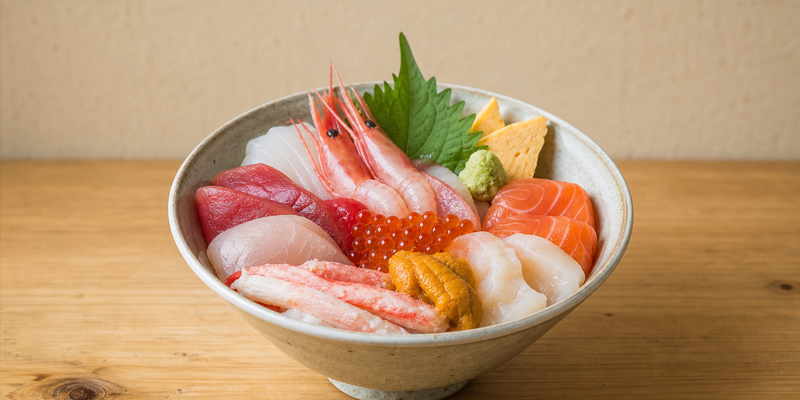
A bowl of vinegared rice crowned with jewels of the sea — tuna, salmon roe, sea urchin, and soy-marinated fish. Kaisendon is a dish the Japanese truly love, eaten as a market breakfast or a treat while traveling. Across six short stories, we explore the toppings, the art of marinating, and regional styles.
- 122 audio guides across Japan — Tokyo, Kyoto & Osaka
- Made for walking — it tells you where to stand and what to look at
- 3 days (1 city + food) ¥2,000 · 1 month (all cities) ¥3,000or this guide only ¥300 (7 days)
- 1Welcome to the World of KaisendonFree
- 2How a Bowl Is Built
- 3The Story of the Bowl
- 4Bowls of the Coast
- 5The Japanese and Kaisendon
- 6Things You Didn't Know
- 7Eating It Well
All chapters of this guide · 7 days — ¥300
Welcome to the World of Kaisendon
Transcript
Welcome to the World of Kaisendon. Picture an early morning in a fish market. The air is cold and smells of the sea. Stall keepers are calling out to one another in loud, cheerful voices. Ahead of you, a woman packs white rice into a deep bowl and hands it over. Then you start to walk. At one stall, a cook slices pink tuna in long, slow strokes. At the next, orange salmon roe glitters in a tray like tiny lanterns. You point, and slice after slice lands on your rice, until the bowl is a small hill of the sea. That is kaisendon: a bowl of rice topped with raw seafood. Kai means sea, sen means fresh, and don is short for donburi, the Japanese word for a bowl of rice with something good on top. Now a surprise, and it's about where it all began. You might expect a dish this famous to have one proud hometown, a single city that can say, "It started here." It doesn't. One shop on the Oga Peninsula, in Akita, calls itself the birthplace. But the city of Hakodate says its own bowl grew up in its morning market, and other markets around Japan tell their own stories too. The common view is that kaisendon grew out of another dish called chirashi sushi, and that it began in many places at about the same time. A famous dish with no single birthplace. Keep that in mind. Over the next seven chapters, we're going to build this bowl from the bottom up. Three things are waiting for you along the way. First, why there is no single birthplace for kaisendon, and what the real story turns out to be. Second, a fish that people in old Edo, the city we now call Tokyo, once turned up their noses at. One clever technique turned it into a star. Third, the secret behind a market bowl that you build however you like, and why the city of Aomori gives that same idea a different name. And one question to carry with you. When a cook prepares sashimi for your bowl, there is one everyday word that cooks never use for what they are doing. What is it? It's a word you would expect to hear in any kitchen in the world. The answer comes in Chapter 2, and once more at the very end. Here's how this guide works. There are seven chapters, about thirty minutes in all. Chapter 2 builds the bowl: the rice, the knife, the garnishes, and a sauce technique. Chapter 3 is the story, from a diary entry in the fifteenth century to the market stalls of the last century. Chapter 4 travels Japan, one bowl at a time. Chapter 5 is about the people who eat it here. Chapter 6 is a handful of facts that surprise almost everyone. And Chapter 7 is short and practical: how to order and eat your bowl with confidence. Ready? Let's start at the bottom of the bowl.
Explore the city. Taste Japan. Hear the Story.
Discover the landmarks of Tokyo, Kyoto & Osaka and Japanese food culture with GuideTunes — an audio guide app made for international travelers. From temples, streets, and historic spots to ramen, sushi, tempura, and local food experiences, GuideTunes helps you understand the stories behind what you see and what you eat. Make every walk and every meal part of your journey in Japan.